
How to Clean Wooden Cabinet Handles | UK Woodpeckers
Learn how to clean wooden cabinet handles the right way. Expert tips on daily care, oiling and protecting handmade oak handles from a Devon woodcraft workshop.
3/22/20269 min read
How to Clean and Maintain Wooden Cabinet Handles: A Complete Guide
Wooden cabinet handles are one of those home details you touch dozens of times a day without thinking about it. That daily contact — hands, moisture, cooking steam, the occasional splash — means they need a little more thought than metal hardware when it comes to cleaning and maintenance.
The good news is that looking after solid oak handles is straightforward. With the right approach, your handles will develop a richer, warmer character over time rather than deteriorating. This guide covers everything you need to know, from daily cleaning to periodic re-finishing.
Know Your Finish First
Before cleaning or treating your wooden handles, it's worth knowing what finish has been applied. Different finishes need slightly different care.
Wooden handles can be finished in several ways — Danish oil, tung oil, linseed oil, hard wax oils, lacquer, and polyurethane varnish are all commonly used in the industry. Each has slightly different care requirements. At UK Woodpeckers we finish our handles in either Osmo Polyx-Oil or clear satin polyurethane depending on the customer's preference and intended use — these are our recommended choices because they offer the best balance of durability, natural appearance, and ease of maintenance. The guidance below focuses on these two finishes, but the general principles apply to most wood finishes.
These principles also apply broadly across hardwood species — ash, iroko, beech, walnut, and other hardwoods all respond well to the same care approach described in this guide. That said, oak remains our timber of choice at UK Woodpeckers for hardware and house signs. Its open grain takes oil and varnish exceptionally well, its natural tannins give it outstanding durability, and its warm golden character genuinely improves with age and use in a way that few other timbers match. Whatever species your handles are made from, the guidance below will serve you well — but if you're choosing new hardware, oak is where we always start.
Osmo Oil Finish
Osmo Polyx-Oil is a hard wax oil made from natural plant oils and waxes that penetrates deep into the wood grain rather than sitting on the surface as a film. As it soaks in, it enhances the natural colour of the oak — deepening the golden tones, enriching the contrast between the early and late wood grain lines, and bringing out the subtle figuring and ray flecks that make each piece unique. The result is a finish that looks like the wood is glowing from within rather than coated from without. It gives a tactile, natural feel that enhances the grain without plasticising it — the handle feels like wood, not like a varnished surface. Over time, with use and occasional re-oiling, an Osmo-finished handle continues to develop character rather than simply wearing down.
Polyurethane Varnish Finish
Clear satin polyurethane forms a hard, protective film on the surface of the wood. Rather than soaking in like an oil, it sits on top and creates a barrier between the timber and the outside world. When applied well, polyurethane dramatically clarifies the grain — the film acts almost like a lens, making the oak's pattern sharper and more defined, and giving the colour a slightly richer, more saturated appearance than bare wood. The satin sheen catches the light evenly across the surface, giving the handle a polished, considered look that suits more contemporary interiors. The trade-off is tactility — a polyurethane surface feels harder and more uniform than an oiled one, which some people prefer for its consistency and ease of cleaning.
If you're not sure which finish your handles have, check your original order confirmation or get in touch with your supplier — at UK Woodpeckers we're always happy to advise on the right care approach for your specific pieces.
Modern Wood Care Products — What's Available
The wood care market has expanded significantly in recent years, giving homeowners more options than ever for maintaining wooden hardware and furniture. Here's a practical overview of what's currently available and where each product fits.
Hard Wax Oils
This is the current gold standard for wooden hardware and furniture in the UK. Hard wax oils combine natural plant oils with waxes to penetrate deep into the grain while leaving a durable, flexible surface layer. The leading products available in the UK are:
Osmo Polyx-Oil — our finish of choice at UK Woodpeckers. Made in Germany from sunflower, soya, and thistle oils, it delivers a rich satin finish that brings out the grain beautifully. Independent UK tests consistently rate it as the best all-rounder for performance, ease of application, and durability. Widely available from specialist timber merchants and online.
Rubio Monocoat — a Belgian premium product that uses molecular bonding technology, requiring only a single coat. It produces an exceptionally matte, natural appearance and is particularly favoured by high-end architects and professional joiners. More expensive than Osmo but outstanding on premium hardwoods like walnut and oak.
Fiddes Hard Wax Oil — a proudly British product made in Wales, offering excellent value and strong performance, particularly on darker timbers. A good choice if you prefer to buy British.
Treatex Hardwax Oil — another UK-made option, formulated on a base of sustainable Jojoba and linseed oil. Slightly thinner in viscosity than Osmo, making it forgiving for DIY application. Produces a warm, golden tone that suits traditional and rustic interiors well.
Furniture Waxes
Traditional paste and liquid waxes — such as Briwax, Renaissance Wax, and Liberon Fine Paste Wax — are more suited to antique or already-finished furniture than raw or newly oiled hardwood handles. They add a light sheen and some surface protection, but don't penetrate the grain and need more frequent reapplication than oils. Avoid silicone-based aerosol waxes entirely on wooden hardware — see the "What to Avoid" section below.
Specialist Wood Soaps
Increasingly popular for oiled surfaces, wood soaps such as Osmo Wash and Care or Woca Wood Soap are pH-neutral cleaners designed specifically for oiled wood. They clean without stripping the finish and leave a light protective residue. A good option for regular cleaning of kitchen handles in high-use environments, as an alternative to plain water.
Our Recommendation
For maintaining UK Woodpeckers handles and signs, we recommend staying with the original finish where possible — Osmo oil for Osmo-finished pieces, and a quality satin polyurethane for varnished pieces. Mixing finish types is rarely a good idea and can produce uneven results. If you're unsure what was applied to your piece, get in touch and we'll advise.
Day-to-Day Cleaning
For both Osmo-oiled and polyurethane-finished oak handles, daily cleaning is simple.
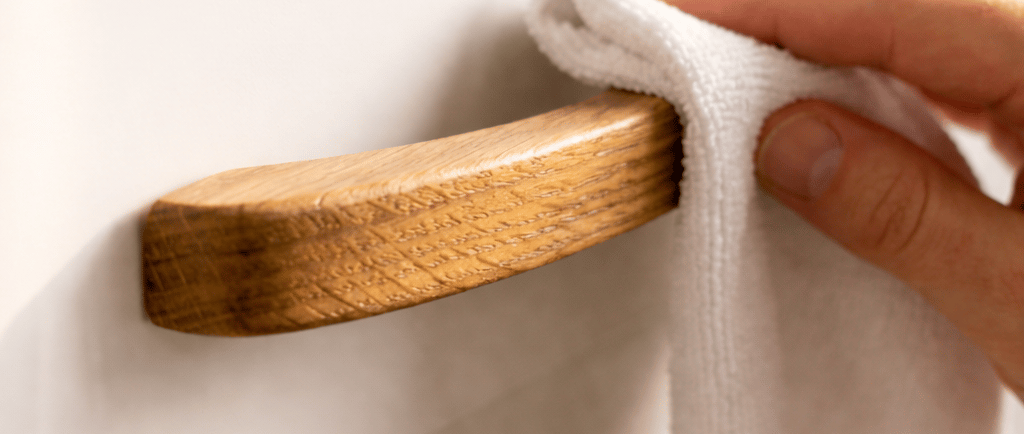
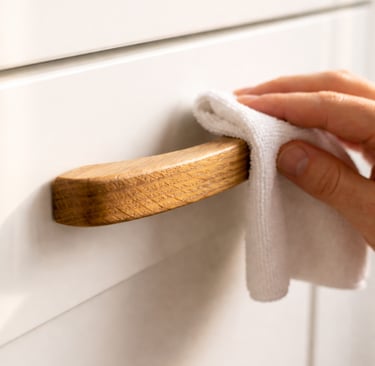
A soft, slightly damp cloth is all you need. Dampen a microfibre cloth with plain water, wring it out well so it's barely moist, and wipe the handle gently. This removes fingerprints, cooking grease, and everyday grime without damaging the finish.
Always wipe in the direction of the grain. Oak has a visible grain running along its length — wiping with it rather than across it prevents micro-scratches building up over time.
Dry immediately. Never leave moisture sitting on a wooden handle. After wiping, follow up with a dry cloth to remove any remaining dampness. This is the single most important habit for keeping wooden handles in good condition.
For stubborn grease, a drop of washing-up liquid diluted in warm water works well. Apply with a damp cloth, wipe clean, then dry thoroughly. Avoid applying neat washing-up liquid directly to the wood.
What to Avoid
These common mistakes are the main cause of premature wear on wooden handles.
Harsh chemical cleaners. Bleach, ammonia-based sprays, and multipurpose kitchen cleaners are too aggressive for wood finishes. They strip the surface protection and can cause discolouration, bleaching, or darkening of the grain. Plain water or a mild diluted detergent is always sufficient.
Abrasive cloths or scourers. Even a slightly rough cloth can scratch an oiled finish. Always use soft microfibre or cotton cloths.
Silicone-based furniture polish. Aerosol polishes often contain silicone which gives a short-term shine but builds up on the surface over time, making future re-oiling or re-varnishing very difficult. Avoid these entirely on wooden hardware.
Steam cleaners. The combination of heat and moisture is particularly damaging to both oil and varnish finishes. Never use a steam cleaner directly on wooden handles.
Soaking or prolonged wet contact. Leaving a wet cloth draped over a handle, or allowing water to pool around the fixing points, will cause the finish to lift and the wood to swell. Always dry promptly after cleaning.
Maintaining an Osmo Oil Finish
One of the great advantages of Osmo oil is that maintenance is simple and non-disruptive — you don't need to strip anything back. You simply re-apply a thin coat when the surface starts to look dry or loses its water-repellency.
Signs your handles need re-oiling:
Water no longer beads on the surface and instead soaks in
The wood looks dry or lighter than usual
The surface feels rougher than it used to
How to re-oil your handles:
Remove the handle from the cabinet if possible — this makes the job much easier and gives a better finish
Clean thoroughly with a damp cloth and allow to dry completely — at least a few hours
Apply a very thin coat of Osmo Polyx-Oil with a lint-free cloth, working in the direction of the grain — less is more with Osmo, thin coats always perform better than thick ones
Leave for 8–10 hours to cure in a well-ventilated area
If a second coat is needed, lightly sand with 240 grit sandpaper and repeat
How often? For kitchen handles in normal use, once every one to two years is usually sufficient. Handles near the hob or sink may benefit from more frequent attention.
Maintaining a Polyurethane Finish
Polyurethane-finished handles need less frequent maintenance but require more effort when they do eventually need attention.
Day to day, the damp cloth and dry routine described above is all that's needed. The hard film surface is more forgiving than an oiled finish.
When the finish shows signs of wear — dull patches, fine surface scratches, or areas where moisture is no longer beading — it's time for a light re-coat.
Remove the handle if possible
Lightly sand the entire surface with 240 grit sandpaper — you're just dulling the existing finish to give the new coat something to key into, not sanding back to bare wood
Wipe away all dust with a clean, dry cloth
Apply a thin, even coat of clear satin polyurethane with a good quality brush
Allow to cure fully — typically 4–6 hours — before reattaching
A second coat after a light 320 grit sand gives the best result
Protecting Handles in High-Use Areas
Kitchen handles near the hob, sink, or dishwasher are exposed to more moisture, heat, and grease than handles elsewhere in the home. A few simple habits make a significant difference.
Wipe handles as part of your regular kitchen clean — a quick wipe-down after cooking prevents grease and steam residue building up over time.
Dry handles after washing up — if your hands are wet when you open a cabinet, a quick dry of the handle takes seconds and prevents repeated moisture exposure.
Consider a more robust finish for wet areas — if you're ordering handles for a kitchen near the sink, it's worth specifying a polyurethane finish rather than oil, as it offers better moisture resistance in high-splash zones.
When to Replace Rather Than Restore
Even well-maintained wooden handles will eventually reach a point where restoration isn't practical — usually after many years of heavy use. Signs that it might be time to replace rather than restore:
Deep cracks running through the grain that can't be filled
Significant swelling or warping that affects the fit
Darkening or staining that penetrates deeper than the finish
In most cases, re-oiling or re-varnishing will restore handles that look tired. But if you do need replacements, having them made by the same maker ensures a perfect match in timber, profile, and finish.
Frequently Asked Questions
Can I use olive oil or coconut oil to condition my oak handles? No — cooking oils will go rancid inside the wood grain, causing an unpleasant smell and potentially darkening the timber in unpredictable ways. Always use a purpose-made wood oil such as Osmo.
My handles have gone slightly grey — is this permanent? Greying is caused by UV exposure and surface oxidation and is usually a surface effect only. Light sanding with 240 grit sandpaper will reveal the fresh wood beneath. Re-oil or re-varnish immediately after sanding to protect the exposed surface.
Can I put wooden handles in the dishwasher to clean them? Never — the combination of heat, steam, and prolonged moisture exposure will cause even the best finish to fail and the wood to crack or warp.
How do I remove a sticky residue from my handles? A small amount of white spirit on a soft cloth will remove most sticky residues without damaging the finish. Test on a hidden area first and dry thoroughly afterwards.
My UK Woodpeckers handles came with either an Osmo or polyurethane finish — how do I know which one? Check your order confirmation — the finish is specified with every commission. If you're unsure, get in touch and we'll confirm exactly what was applied and advise on the right maintenance approach.
Need Your Wooden Hardware Professionally Restored?
If your handles, house signs, or other wooden pieces have seen better days and you'd rather have them professionally restored than tackle it yourself, we offer a timber restoration service from our Devon workshop.
Whether it's a set of oak handles that have dried out and lost their finish, a house sign that's been weathered by years of exposure, or a cherished piece of furniture that needs bringing back to life — get in touch and we'll advise on the best approach.
Shop Our Oak Hardware Collection
Looking for new solid oak cabinet handles for your kitchen, bathroom, or furniture project? Browse our handmade collection — every handle is finished to the same high standard described in this guide.
Read Our Full Oak Care Guide →
UK Woodpeckers — Handcrafted in Devon, UK.
© 2026 UK Woodpeckers Handcrafted in Devon, UK. All rights reserved.
Contact: info@ukwoodpeckers.co.uk