The Tree of Life Symbol Meaning, History and Why We Carve It in Oak
Discover the Tree of Life symbol meaning—its ancient roots, what it represents today, and why solid oak is the perfect material to carve it by hand in the UK
4/13/20268 min read
The Tree of Life Symbol: Meaning, History and Why We Carve It in Oak
Meta description: Discover the deep meaning behind the Tree of Life symbol — its ancient roots, what it represents today, and why solid oak is the perfect material to carve it in.
Focus keyword: tree of life symbol meaning
URL slug: tree-of-life-symbol-meaning
Few symbols have endured as long, or travelled as far, as the Tree of Life. From ancient Mesopotamia to Celtic Britain, from Norse mythology to modern home décor, the image of a tree with spreading branches and deep roots has carried profound meaning across thousands of years and dozens of cultures. It is one of the most universally recognised symbols in human history — and one of the most personally resonant.
At UK Woodpeckers, the Tree of Life is central to what we do. We carve it into solid oak cabinet knobs, into wall art pieces, and into lamps that cast its branches in warm light across a room. We chose oak deliberately — not just because it's the timber we know best, but because the connection between oak and the Tree of Life is ancient, deep, and entirely appropriate. More on that shortly.
First, the symbol itself.
What Does the Tree of Life Mean?
The Tree of Life doesn't have a single fixed meaning — it has accumulated meaning across cultures and centuries, layer upon layer, until it has become one of the richest symbols in existence. But certain themes recur consistently, in almost every tradition that has used it.
Connection
The most fundamental meaning of the Tree of Life is connection. The tree bridges three worlds — its roots reach into the earth below, its trunk stands in the living world, and its branches extend toward the sky above. In almost every culture that has used the symbol, this vertical structure represents the connection between different realms of existence: the physical and the spiritual, the past and the future, the individual and the universal.
This sense of connection extends to human relationships too. A tree with many branches from a single root is a natural metaphor for family — shared origins, growing in different directions, but fundamentally connected. This is why the Tree of Life is so often associated with family, ancestry, and the bonds that hold people together across generations and distance.
Growth and Renewal
Trees are among the most visible expressions of natural growth. They grow slowly, patiently, adding a ring with every year. They lose their leaves in autumn and renew them in spring. They can be damaged, cut back, and still regenerate from their roots. For these reasons, the Tree of Life has always been associated with growth, resilience, and the cyclical nature of life — the idea that endings are always also beginnings.
Strength and Endurance
A mature tree is one of the most structurally impressive things in nature — capable of standing for centuries, withstanding storms that would flatten most other things, and outliving the humans who planted it. The Tree of Life inherits this meaning. It represents strength that comes not from rigidity but from deep roots — the kind of endurance that bends without breaking.
Wisdom and Knowledge
In several traditions — most famously the Judeo-Christian Garden of Eden, but also in Norse, Hindu, and Buddhist cosmology — the Tree of Life is associated with knowledge and wisdom. The idea that deep roots and long growth lead to understanding has made the tree a consistent symbol for learning, insight, and the accumulation of wisdom over time.
Interconnectedness
Perhaps the most contemporary resonance of the Tree of Life is its expression of interconnectedness — the idea that all living things are part of a single system, sharing roots, dependent on each other, and part of something larger than themselves. In an age increasingly aware of ecological relationships, the Tree of Life speaks to our connection with the natural world as much as with each other.
The Tree of Life Across Cultures
Celtic Tradition
For the ancient Celts, the oak tree was the Tree of Life — the Crann Bethadh. The Celtic world tree stood at the centre of existence, connecting the heavens, the living world, and the realm of roots and ancestors below. Druids conducted their ceremonies in oak groves, and the tree represented not just physical strength but spiritual authority and divine connection.
The Celtic Tree of Life design — characterised by its interwoven branches and roots forming a continuous, unbroken circle — is one of the most recognisable versions of the symbol today. Its circular form emphasises the continuity of life: there is no beginning and no end, only an ongoing cycle.
Norse Mythology
In Norse tradition, the world tree was Yggdrasil — a great ash tree whose roots reached into three worlds and whose branches sheltered nine realms of existence. Birds nested in its canopy, a dragon gnawed at its roots, and squirrels carried messages between the realms along its trunk. Yggdrasil was the axis of the Norse universe — the structure around which all of existence was organised.
Ancient Egypt and Mesopotamia
The Tree of Life appears in ancient Egyptian mythology as the Persea tree, from which the gods emerged. In Mesopotamian traditions, it appears on some of the oldest surviving carvings and cylinder seals — a stylised tree flanked by worshippers, representing divine blessing and the source of all life.
Kabbalah
In Jewish mystical tradition, the Kabbalistic Tree of Life is a diagram of ten interconnected spheres (Sefirot) representing the attributes of God and the structure of creation. It is one of the most complex and studied versions of the symbol, and has influenced art, philosophy, and spirituality for centuries.
Buddhism and Hinduism
The Bodhi tree — under which the Buddha achieved enlightenment — is a Tree of Life in the Buddhist tradition. In Hinduism, the Ashvattha or sacred fig tree represents the eternal and the imperishable. Both traditions connect the tree to spiritual awakening and the deepest truths of existence.
Why Oak is the Right Material
When we carve the Tree of Life at UK Woodpeckers, we use solid British oak. This is not simply a practical decision — it is a historically and symbolically appropriate one.
The Celtic Tree of Life was always the oak. In the culture that gave us the most recognisable version of this symbol, the oak was the sacred tree — the axis connecting heaven, earth, and the roots below. When you carve the Tree of Life into oak, you are working with the original material the symbol was associated with.
Beyond history, oak has qualities that make it the ideal physical expression of Tree of Life symbolism. It is strong and enduring — a properly maintained oak piece will last for generations. Its grain is unique to each board, meaning every Tree of Life we carve is genuinely one of a kind — no two are identical, just as no two trees are identical. And oak deepens and enriches with age and use, developing a patina that makes it more beautiful over time rather than less.
There is something fitting about a symbol of growth and endurance being expressed in a material that grows slowly, endures for centuries, and improves with the passage of time. Oak and the Tree of Life are, in every meaningful sense, made for each other.
Our Tree of Life Collection
Personalised Oak Tree of Life Cabinet Knob
Our most accessible Tree of Life piece — a solid oak cabinet knob with a precision-engraved Tree of Life design. CNC carved to capture every branch and root in crisp detail, then hand-finished in our Devon workshop.
Available as a standard Tree of Life design or personalised with initials, a short text, or your own custom motif. Every knob is a small but meaningful detail — something you'll touch every day and notice every time.
From £6.95 — Shop Cabinet Knobs →
Hand-Carved Oak Tree of Life Wall Art
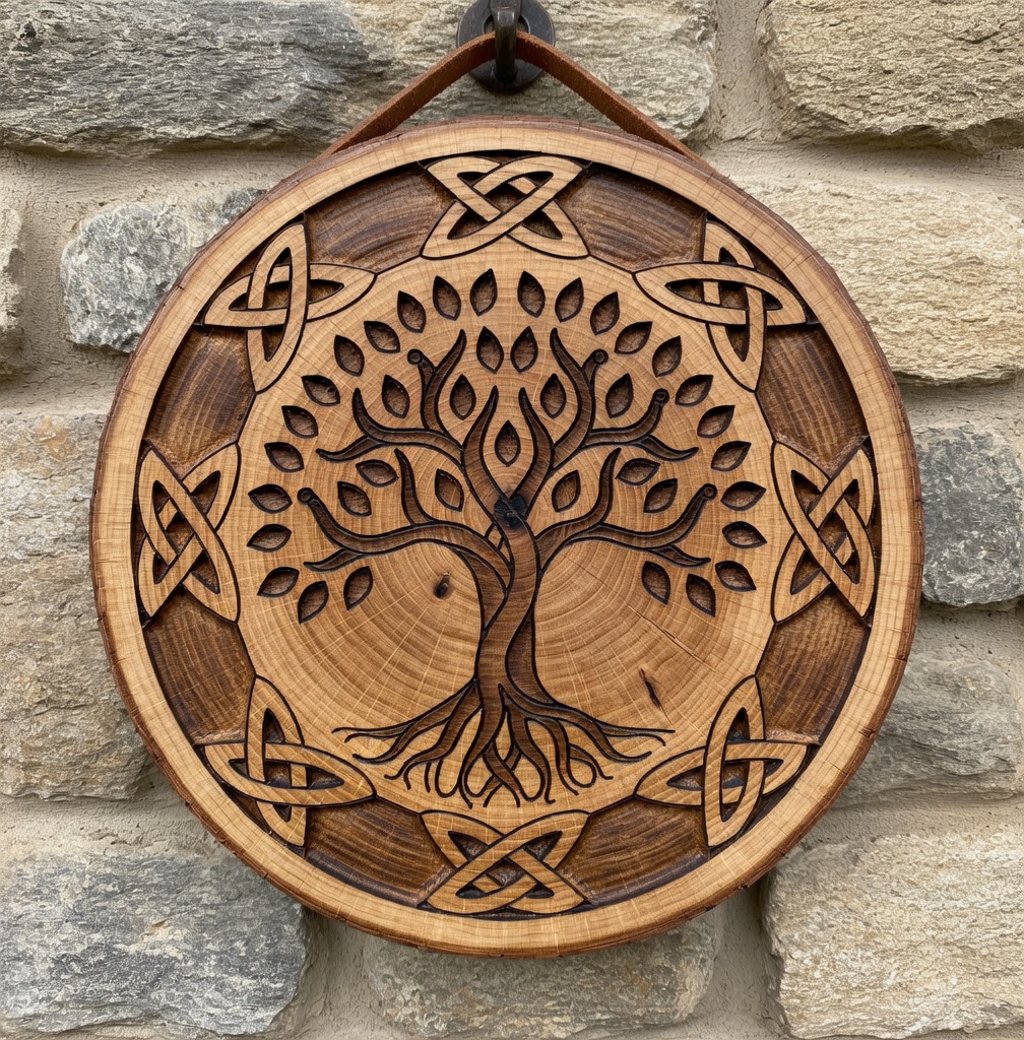
A substantial decorative piece for the home — our solid oak Tree of Life wall art is CNC carved in high relief and hand-finished to bring out every detail of the design. The three-dimensional depth of the carving catches the light differently throughout the day, giving the piece a quality that flat prints simply cannot match.
This is a piece that works in living rooms, hallways, bedrooms, or any space where you want to bring a sense of natural warmth and meaning. It makes an exceptional gift for any occasion where the symbol's associations — family, growth, connection, endurance — feel relevant.
From £78.99 — Shop Wall Art →
Personalised Oak LED Tree of Life Lamp
Our most distinctive Tree of Life piece. A solid oak lamp with a touch-dimmable LED panel engraved with the Tree of Life design — when illuminated, the branches and roots are cast in warm light that creates a remarkable effect in any room.
USB powered and touch-dimmable, it suits bedside tables, shelves, desks, or any space where you want ambient lighting with genuine meaning and character. Available personalised with a name, date, or short message.
From £98.99 — Shop Tree of Life Lamp →
The Tree of Life as a Gift
Because the Tree of Life carries such universal meaning — connection, family, growth, endurance — it translates naturally into gift giving for almost any occasion.
Housewarming — a Tree of Life piece for a new home carries the symbolism of putting down roots and building a life in a place.
Wedding or anniversary — the intertwined branches and shared roots speak directly to the bonds of partnership and shared growth.
New baby — the tree as family symbol, with branches growing from a common root, resonates deeply with the arrival of a new member.
Bereavement — the Tree of Life is one of the most appropriate memorial symbols, representing continuity, the cycle of life, and the endurance of roots even when a branch is lost.
Milestone birthdays — the associations with wisdom, endurance, and the passage of time make it a thoughtful gift for significant birthdays.
If you're unsure which piece is right, our cabinet knob is the most accessible starting point — small enough to be an add-on gift, meaningful enough to stand alone.
Frequently Asked Questions
What does the Tree of Life symbolise in simple terms? At its core, the Tree of Life represents connection — between people, between generations, between the physical and the spiritual. It also carries meanings of growth, strength, resilience, and the idea that all living things are part of something larger than themselves.
Is the Tree of Life a religious symbol? It appears in many religious traditions — Christianity, Judaism, Buddhism, Hinduism, and Celtic paganism among others — but it is not exclusively religious. It is widely used as a secular symbol of family, nature, and interconnectedness.
Why is oak used for Tree of Life carvings? Oak was the original Tree of Life in Celtic tradition, which gave us the most recognisable version of the symbol. It is also one of the most durable and characterful hardwoods — qualities that align naturally with the symbol's associations of strength and endurance.
Can I personalise a Tree of Life piece? Yes — our cabinet knobs and lamp are available personalised with initials, names, dates, or short messages. Get in touch if you have a specific personalisation in mind and we'll advise on what's possible.
Do you offer gift wrapping or personalised messages? Yes — if you're ordering as a gift, leave a note at checkout and we'll ensure the packaging is suitable. We can also include a personalised message card.
A Symbol That Endures
The Tree of Life has outlasted empires, religions, and entire civilisations. It has been carved into stone, woven into textiles, painted onto walls, and cast in metal across thousands of years of human history. It endures because it speaks to something fundamental — the desire to feel connected, to grow, to put down roots, and to be part of something that continues beyond ourselves.
At UK Woodpeckers, we carve it into solid oak because oak endures too. A piece made with care from honest materials, in a small Devon workshop, carries a little of that same meaning — something made to last, to be touched and noticed every day, and to grow more beautiful with the passage of time.
Explore Our Tree of Life Collection →
UK Woodpeckers — Handcrafted in Devon, UK.
© 2026 UK Woodpeckers Handcrafted in Devon, UK. All rights reserved.
Contact: info@ukwoodpeckers.co.uk