
History of Oak Craftsmanship | From Ancient Forests to Devon
Discover the history of oak craftsmanship — from sacred Celtic groves and Viking longships to British Tudor furniture and modern handmade hardware in Devon.
3/26/20268 min read
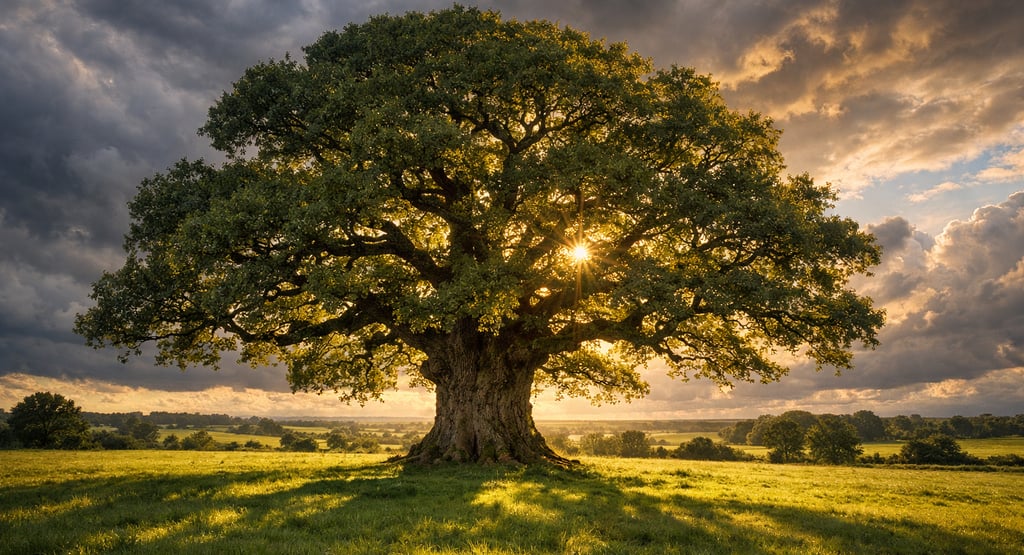
The History of Oak in European Craftsmanship: From Ancient Forests to Modern Workshops
There is no timber quite like oak. No other wood has shaped European civilisation so profoundly — from the ships that built empires to the beams that hold up medieval cathedrals, from the barrels that age whisky and wine to the furniture passed down through generations. Oak is not simply a material. It is the material — the thread that runs through the entire history of European making.
At UK Woodpeckers, working with oak every day in our Devon workshop, we feel that history in every piece we cut. Oak's open grain is unlike any other hardwood — each board tells a different story, every ray fleck and growth ring a record of decades of slow, patient growth. It is precisely this uniqueness that draws us to it. No two pieces are identical, and that individuality gives every handle, sign, or carved piece we make a character and personality that no manufactured product can replicate.
This is the story of oak — and why it remains, after thousands of years, the craftsperson's timber of choice.
The Sacred Oak — Ancient Roots
Long before anyone thought to build furniture or carve handles from it, oak was sacred.
To the ancient Celts, the oak was the king of trees — the axis around which the natural and spiritual worlds turned. The word "druid" is widely believed to derive from the Proto-Celtic dru-wid, meaning "oak knowledge" or "those with knowledge of the oak." Celtic priests conducted their rites in oak groves, and the tree was associated with strength, endurance, and the divine.
The Tree of Life — one of the most enduring symbols in human culture — is rooted in this oak tradition. The Celtic Crann Bethadh, or Tree of Life, was almost universally depicted as an oak. Its canopy represented the heavens, its trunk the living world, and its roots the realm beneath — the oak as the axis connecting all existence. This symbolism transcended Celtic culture and echoes through Norse, Greek, and wider European mythology. At UK Woodpeckers, when we carve the Tree of Life into solid oak — whether on a cabinet knob, a wall art piece, or a lamp — we are not simply reproducing a decorative motif. We are working with the original material the symbol was always associated with. Oak and the Tree of Life are, in the deepest historical sense, inseparable.
The Romans shared this reverence. Jupiter, the king of the gods, was associated with the oak, and Roman soldiers who saved a comrade's life in battle were awarded the corona civica — a crown woven from oak leaves. The oak was a symbol of civic honour, of life given and life saved.
In Norse mythology, the oak was sacred to Thor, the god of thunder and strength — which made a certain practical sense, as oaks are famously struck by lightning more than almost any other tree, their height and electrical conductivity making them natural lightning rods. The Vikings, unsurprisingly, built their longships largely from oak.
This near-universal reverence across European cultures speaks to something fundamental about the timber. Oak earns its respect. It is dense, hard, and strong, yet flexible enough not to shatter under impact. It resists rot and insect attack. It grows slowly — sometimes over centuries — accumulating the tight, complex grain that makes it so beautiful and so durable.
Oak and the Medieval World
In medieval Europe, oak was the building material of civilisation. From approximately the 11th to the 17th century, virtually every significant structure in northern Europe was built with oak — churches, cathedrals, manor houses, market halls, and the humble homes of ordinary people.
The great timber-framed buildings that still stand across England — the medieval guildhalls of York, the ancient barns of the Cotswolds, the magnificent hammer-beam roofs of Westminster Hall — are oak structures. Some have stood for over 700 years. The oak beams that support Westminster Hall's roof were felled in the late 14th century and are still performing their function today.
Oak's role in medieval building wasn't merely structural. Skilled joiners and carvers used it to create the extraordinary decorative work that filled churches and great houses — misericords, rood screens, choir stalls, and the elaborately carved panelling that lined the walls of Tudor interiors. Medieval craftsmen understood oak's character intimately: they knew how it split, how it carved, how it responded to chisels and planes, and how it aged. They selected each timber for its specific use, reading the grain to understand the wood's strength and beauty.
Devon, where UK Woodpeckers is based, has a particularly rich medieval timber heritage. The county's wool trade wealth funded the construction of some of England's finest medieval churches, many of which contain extraordinary carved oak screens and benches — the work of craftsmen who understood this timber as well as anyone who has ever worked it.
The Age of Oak — Ships, Empire, and the Royal Navy
If medieval Europe was built from oak, the age of exploration and empire was sailed on it.
Between roughly 1500 and 1850, the oak forests of Europe provided the timber that built the great navies of the world. A single first-rate Royal Navy warship required approximately 2,000 mature oak trees — trees that might have taken 150 years to grow. The construction of Nelson's flagship HMS Victory, launched in 1765 and still afloat at Portsmouth today, consumed around 6,000 trees.
The Royal Navy's demand for oak was so vast that it drove the planting of entire forests. Many of the great oak woodlands that still stand in southern England — the Forest of Dean, the New Forest, parts of the South Hams in Devon — were planted or managed specifically to supply the navy with shipbuilding timber. Walk through these woods today and you are walking through what was once a strategic national resource.
Oak's properties made it uniquely suited to shipbuilding. Its density meant it could resist cannonball impacts that would shatter softer woods. Its natural tannins made it resistant to the rot and marine borers that devastated lesser timbers. And its ability to be steam-bent into complex curved shapes — the ribs and frames of a ship's hull — made it irreplaceable in an age before steel.
This maritime heritage gives oak a particular resonance in Devon, a county whose ports — Plymouth, Dartmouth, Exeter — were central to British naval history. The timber that shaped the world's oceans grew in the same landscape where we work today.
Oak Furniture — The Tradition of the Joined and Carved Piece
Alongside its structural and maritime roles, oak has always been the furniture maker's timber of choice.
Tudor furniture — the great chests, court cupboards, and refectory tables of the 16th and early 17th centuries — was almost exclusively oak. The Tudors valued oak for the same reasons the medieval builders had: its strength, its durability, and above all, its grain. Tudor craftsmen celebrated oak's open, pronounced grain rather than hiding it under paint or veneer. The texture was part of the aesthetic — a declaration of natural quality.
The joined furniture tradition that flourished in England from the 15th century onwards produced pieces of extraordinary skill and beauty. Mortise and tenon joints, drawbored pegs, hand-carved linenfold panels and guilloche borders — these were the techniques of craftsmen who spent entire careers learning oak's behaviour and working with it rather than against it.
By the 17th century, as walnut and later mahogany became fashionable among the wealthy, oak retreated somewhat from high-status furniture — but it never disappeared. Country furniture makers across Britain continued to work in oak throughout the 18th and 19th centuries, producing the robust, honest pieces that furnished farmhouses, inns, and the homes of working people. These pieces often survive today when their more fashionable walnut and mahogany contemporaries have long since perished — a testament to oak's fundamental durability.
The Industrial Age and Oak's Resilience
The Industrial Revolution transformed how furniture and household objects were made. Machine production made it possible to produce objects far faster and more cheaply than hand craftsmen ever could. Many traditional materials and techniques fell away entirely.
Oak, remarkably, survived this disruption. It adapted. Victorian and Edwardian furniture makers continued to use it extensively, and the Arts and Crafts movement of the late 19th century — a deliberate reaction against industrial production — actively celebrated oak as the honest, natural alternative to the machine-made. William Morris, the movement's driving force, was a passionate advocate for oak furniture and the hand craftsmanship it represented.
The Arts and Crafts legacy is still felt in British craft today. The movement established a lasting tradition of valuing handmade objects above mass-produced ones — and of seeing natural materials like oak as inherently more worthy than synthetic or industrially processed alternatives. It is a tradition that directly informs what we do at UK Woodpeckers.
Oak Today — A Living Tradition
A thousand years after medieval craftsmen raised the great timber halls of England, oak is still the craftsperson's first choice. Its qualities haven't changed. Its grain is still unique — every board different from every other, shaped by decades of growth in a particular place under particular conditions.
This is what we find most compelling about oak at UK Woodpeckers. When we cut a board for a cabinet handle or a house sign, we are working with something that grew for perhaps sixty or eighty years before reaching our workshop. The grain we see — those golden rays, those subtle variations in colour and texture — is a record of that growth. Every knot, every medullary ray, every shift in the grain direction tells a story.
No two pieces of oak are the same. And because no two pieces are the same, no two handles, signs, or carved pieces we make are identical. Each has its own character, its own personality — a quality that no manufactured product can replicate, no matter how sophisticated the machinery.
This is the deepest reason why oak has endured as the craftsperson's timber across millennia. It is not merely strong or durable, though it is both. It is alive in a way that synthetic materials never can be — a natural record of time, place, and growth that brings something irreplaceable into any home it enters.
From Celtic sacred groves to Devon workshop benches, the story of oak and human making is one long, unbroken thread. We're proud to be part of it.
Frequently Asked Questions
Why is oak so commonly used in British furniture and architecture? Oak combines exceptional strength and durability with a beautiful, characterful grain. Its natural tannins give it rot and insect resistance that few other timbers match, and it can be worked — carved, jointed, steam-bent — with great precision. It has been the dominant building and furniture timber in Britain for over a thousand years.
How long does it take an oak tree to mature for timber use? Timber-quality oak typically takes between 80 and 150 years to reach usable size, depending on growing conditions. The slow growth is precisely what creates oak's dense, tight grain and outstanding mechanical properties.
What is special about English oak compared to other species? English or European oak (Quercus robur) has a particularly pronounced open grain with prominent medullary rays — the silver-grey flecks visible especially in quarter-sawn timber. This gives it a visual character that most other oak species don't replicate. It is also naturally higher in tannins than American white oak, giving it better outdoor durability.
Is oak a sustainable choice for furniture and hardware? Yes — when sourced responsibly from managed woodlands, oak is a highly sustainable material. British oak in particular is a renewable resource grown on these islands, with a far lower environmental footprint than imported tropical hardwoods.
Why does oak develop character with age? Oak contains natural tannins and oils that react with light, air, and handling over time. An oiled oak handle or sign will gradually deepen in colour and develop a patina — a surface quality earned through use — that makes each piece increasingly individual. This ageing process is considered one of oak's greatest qualities by craftspeople and collectors alike.
What is the connection between the Tree of Life and oak? The Celtic Tree of Life — the Crann Bethadh — was almost always depicted as an oak tree. In Celtic belief, the oak represented the axis connecting heaven, earth, and the underworld. This symbolism also appears in Norse and Greek mythology. When we carve the Tree of Life motif into solid oak at UK Woodpeckers, we are working with the original timber the symbol was always associated with — oak and the Tree of Life are historically and symbolically inseparable.
Oak Handles, Signs, and Tree of Life Carvings — Handcrafted in Devon
If this history of oak resonates with you — if you want hardware, signage, or carved art for your home that carries that same tradition of quality, character, and natural beauty — take a look at what we make at UK Woodpeckers.
Every piece starts as premium British oak, cut and shaped with CNC precision and hand-finished in our Devon workshop. The grain you see is the grain that grew — individual, unrepeatable, alive.
Request a Bespoke Commission →
UK Woodpeckers — Handcrafted in Devon, UK.
© 2026 UK Woodpeckers Handcrafted in Devon, UK. All rights reserved.
Contact: info@ukwoodpeckers.co.uk