
Solid Oak Cabinet Handles: The Complete Buyer's Guide
BUYING GUIDES
3/6/20265 min read
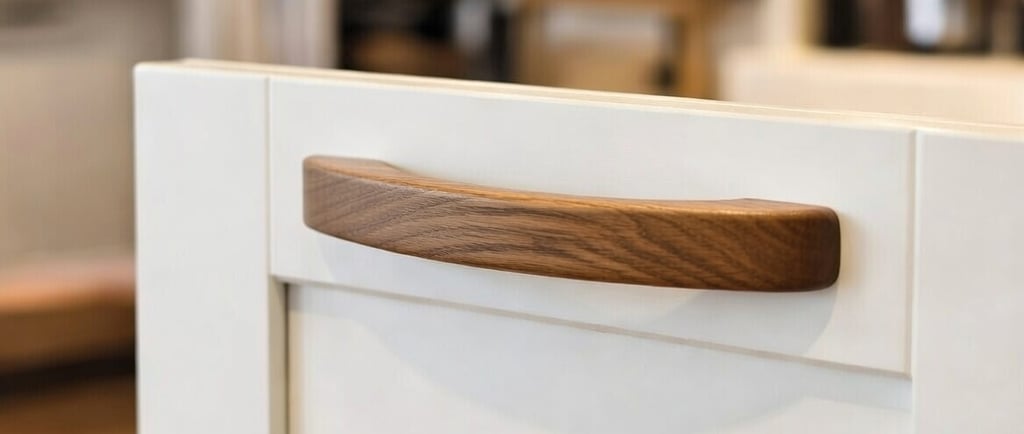
Solid Oak Cabinet Handles: The Complete Buyer's Guide
When you're renovating a kitchen, updating a bathroom, or breathing new life into a piece of furniture, it's tempting to focus on the big things — the paint colour, the worktop, the tiles. But nothing transforms a space quite like the hardware. A solid oak cabinet handle is one of the smallest changes you can make to a room, and one of the most impactful.
This guide covers everything you need to know before buying solid oak cabinet handles in the UK: sizes, styles, finishes, fitting, and the questions worth asking any maker before you buy.
Why Choose Solid Oak Over Other Materials?
Walk into any large DIY chain and you'll find rows of cabinet handles made from zinc alloy, brushed chrome, or hollow-cast metal. They're cheap, uniform, and everywhere — which is precisely the problem.
Solid oak handles offer something fundamentally different:
Warmth. Natural wood brings an organic warmth to kitchens and furniture that no metal can replicate. Oak in particular has a rich, golden grain that deepens beautifully with age.
Durability. Oak is one of Britain's hardiest native hardwoods. A well-made solid oak handle, properly finished, will outlast the cabinet it's fitted to.
Tactility. There's a reason we describe good hardware as "jewellery for the home." The way something feels in your hand every single day matters. The weight and smoothness of solid oak is a pleasure that hollow metal simply cannot match.
Sustainability. UK-sourced oak is a renewable, biodegradable material. Choosing solid hardwood over mass-produced metal is a straightforward environmental win.
The Main Styles of Oak Cabinet Handle
Not all oak handles are the same. Here's a breakdown of the most popular styles and where they work best.
Bar Pulls
The most versatile style. A straight or gently curved bar, fixed at both ends, that suits everything from shaker kitchens to contemporary fitted wardrobes. Oak bar pulls work especially well on deep drawer fronts where you need a firm, two-handed grip.
Best for: Kitchen drawers, wardrobe doors, utility room cabinets.
D-Ring Pulls
A classic D-shaped handle fixed at a single central point. The Scandi-inspired variation — with a minimal, rounded profile — has become enormously popular for its clean, understated look.
Best for: Bedroom furniture, bathroom vanity units, smaller cabinet doors.
Knobs
A single-point fix, usually round or oval. Oak knobs add a heritage feel and suit traditional or country-style interiors particularly well. They're also the most economical option when you have a lot of cupboards to dress.
Best for: Kitchen cupboard doors, freestanding furniture, larder units.
Bespoke Profiles
If none of the standard shapes quite fit your vision, a bespoke commission is more accessible than most people assume. A skilled woodworker can create handles to your exact dimensions and profile — particularly valuable if you're matching existing hardware in a period property.
Best for: Listed buildings, restoration projects, one-of-a-kind furniture pieces.
How to Choose the Right Size
Getting the size wrong is the most common mistake when buying cabinet handles. Here's a straightforward guide.
For drawer fronts: The handle should be roughly one-third the width of the drawer. So a 600mm wide pan drawer suits a 200mm handle. Going too small looks out of proportion and feels flimsy to use.
For cupboard doors: A single knob or short pull (64–96mm fixing centres) works well on standard-width doors (up to around 400mm). Wider doors benefit from a longer bar pull to give more leverage when opening.
Fixing centres: This is the measurement between the two screw holes. Standard fixing centres are 64mm, 96mm, 128mm, and 160mm. Always measure your existing holes before ordering if you're replacing old hardware — it avoids unnecessary drilling.
Projection: How far the handle sticks out from the surface. For drawers in tight spaces (next to a wall or an appliance), keep projection under 35mm. For standalone furniture, a deeper projection can feel more luxurious.
Finishes and Treatments to Look For
Raw oak needs protection to perform well in a kitchen or bathroom environment. Ask any supplier about their finishing process before you buy.
Danish Oil penetrates the grain and enhances the natural colour, leaving a subtle satin finish. It's easy to maintain with a periodic re-application and is the most popular choice for a natural, unpretentious look.
Hard Wax Oil (such as Osmo) offers slightly better moisture resistance than Danish oil. A good choice for kitchen handles that will encounter cooking steam and occasional splashes.
Lacquer provides a harder, more protective surface film. It gives a more uniform, polished appearance — closer to a furniture finish than a raw wood feel. Less tactile than oiled wood, but more durable in high-traffic environments.
Unfinished Some makers supply handles unfinished so you can match them precisely to your existing wood tones. This is worth considering if you're fitting handles to painted furniture — you can prime and paint the oak to match your cabinet colour exactly.
What to Ask Before You Buy
Whether you're buying from a craft market, an online shop, or commissioning directly, these questions will tell you a lot about the quality you're getting.
What species of oak is it? European oak (Quercus robur) is the gold standard for British hardwood handles. Some suppliers use American white oak or even engineered oak composites — not necessarily inferior, but worth knowing.
Is it solid wood throughout? Some handles are solid on the face but use cheaper timber or MDF for the core. Ask specifically.
Where is it made? UK-made means shorter supply chains, better quality control, and the ability to inspect samples or request small modifications. Imported handles vary wildly in quality.
What's the fixing included? Our handles come with zinc-plated fixings — a practical, cost-effective choice that performs well in normal indoor conditions. For bathrooms or high-humidity environments, you may want to upgrade to stainless steel fixings separately.
What's the lead time for bespoke orders? Genuine handmade items take time. If a supplier quotes you three days for a full bespoke kitchen set, be sceptical.
How Many Handles Do I Need? (Quick Reference)
| Room | Typical Handle Count |
| Average kitchen (10–15 units) | 15–25 handles |
| Bathroom vanity unit | 2–4 handles |
| Bedroom wardrobe (4 doors, 2 drawers) | 6–8 handles |
| Freestanding dresser | 4–8 handles |
It's always worth ordering 10–15% extra for a bespoke or handmade product. Natural materials vary slightly between batches, and having spares means you can replace a damaged handle years later with a perfect match.
Why Handmade Oak Handles Are Worth the Investment
Mass-produced handles are designed to a price point. The oak used is often fast-grown, with wide, unpredictable grain. Corners are cut in finishing. The result is a handle that looks fine in photos and feels cheap in your hand.
Handmade solid oak cabinet handles — particularly those crafted with CNC precision and then hand-finished — are a different proposition entirely. Every piece is worked to ensure the grain runs correctly, the edges are smooth to the touch, and the finish is even and durable. These are handles you'll use every single day for twenty years. The difference in quality is something you feel rather than see.
At UK Woodpeckers, every oak handle begins as a premium British hardwood blank, cut and shaped with CNC accuracy, then hand-finished in our Devon workshop. No two pieces are identical — and that's exactly the point.
Ready to Find Your Perfect Oak Handle?
Browse our collection of solid oak cabinet handles, drawer pulls, and architectural hardware — or get in touch to discuss a bespoke commission tailored to your exact project.
UK Woodpeckers — Handcrafted in Devon, UK.
© 2026 UK Woodpeckers Handcrafted in Devon, UK. All rights reserved.
Contact: info@ukwoodpeckers.co.uk